Wednesday, September 1, 2010

Vigo, Truffaut, Melville and...Woo?

The very idea of a film remake would have likely disgusted Vigo, Truffaut, Godard, and Melville. A film, in their eyes, should be a fresh take on old ideas, bringing new insights and wonderful images onto the screen - but it should also pay simultaneous tribute to those before them who have laid the framework and been the prototype for brilliance. Take, for example, Vigo's stunning L'Atalante (1934), a film that so inspired Francois Truffaut at the impressionable age of 14 that he later made the equally great The 400 Blows. Both were influential in their own right - Vigo's film, the epitome of poetic realism, laid the basic groundwork for film noir and even French New Wave cinema, while Truffaut's film later became the jumping-off point for the New Wave. Both presented wholly original techniques, ideas, and storytelling, but paid homage to the ideas of the greatest artists before them (the Lumiere brothers' influence on Vigo is unmistakable, and the influence of Vigo's films saturate nearly every frame of Truffaut's work).

Take a look at a shot from a scene from
L'Atalante:


And then the homage paid to Vigo by Truffaut in
The 400 Blows - a film which refrains from being derivative while still honoring the brilliance to come before it:


It's almost
exactly the same shot, but into two different movies! Two phenomenal, completely different (well, not completely different) films.

And then I read this, from the AV Club:

"Woo is looking to 'line up A-list talent' to star in English-language remakes of Jean-Pierre Melville’s Le Samourai and Woo’s own 1989 breakthrough The Killer. That Woo wants to put his own, slow-motion-dove spin on Le Samourai isn’t all that surprising—he’s long spoken of Melville as a huge influence, and he’s openly talked about his desire to remake it."

Admirable as it is to desire to make an homage to the greats to come before you, I literally want to vomit at the thought of a remake of Le Samourai. It is one of my favorite films, a controlled and gorgeous masterpiece, which, much like Psycho before it, has absolutely no need to be remade. It's like saying: "Hey, I just bought a new car, which just so happens to be running perfectly, but I'm going to take it into the shop to have the engine fixed."

If you consider Melville to be one of your influences, Mr. Woo, then I would suggest spitting on Melville's grave before you remake Le Samourai. It would probably be more respectful to him and his work when it's all said and done.

Tuesday, March 2, 2010

The most overrated films of 2009

I really only have three overrated films I want to talk about, so you know to avoid them. Or so you can argue with me. Keep in mind this is not a discussion of the worst movies of the year.
I don't want to make any enemies, but I don't really consider Avatar to be a movie - it feels more like it belongs in an amusement park, where viewers can "ooh" and "aah" at the screen instead of marveling at its storytelling aspects. It's important for a movie to be visually pleasing (or at least coherent - and Avatar is), but its even more important that the film be imbued with real characters and emotional storytelling. We should learn something about the human condition from movies, and Avatar doesn't do that. The story is melodrama at best, eye-rolling at worst. Should it win Oscars for visual effects? Definitely. Does it belong as a Best Picture Nominee among films like The Hurt Locker and Up? Definitely not.

George Clooney is a great actor when he's not playing someone like himself. Ryan Bingham in Jason Reitman's Up in the Air is too cool, too suave, too charming, too...Clooney. Conversely, his performances in Syriana and Michael Clayton were both remarkable. Michael Clayton riffed off of Clooney's star power; in the film, Clayton was charming and cool-headed on the outside, but on the inside was a deeply damaged individual. You could sense that. Up in the Air, however, felt phony and manipulative to me. Was Clooney's performance good? Yes, but that's because he was essentially playing Clooney. The dialogue felt pithy, the characters one-dimensional. For some reason I felt exploited by Reitman's condescension of Bingham, who is essentially paid to fire people from their jobs. Why are all these rich actors and directors (Reitman, Clooney, Farmiga, etc.) wagging their fingers at Bingham, a man who exploits misfortune for his own gain? Aren't they sort of doing the same thing?

Finally (and I hate to do this), I have to bring up issues I had with Lee Daniels' Precious. Before I say anything else, I want to clear two things up: (1) Yes, the performances are all incredible - some of the best of this, or any, year. Mariah Carey, Mo'Nique, and Gabourey Sidibe are all extraordinary actresses, and I would love nothing more than to see them all rewarded for their devastating performances. (2) I hate to rag on a movie that has done so much from so little, but I have to. The movie is powerful, yes. But Lee Daniels' heavy-handed direction do the film no favors. The strange scenes of Precious' fantasies are carelessly mishandled. What purpose do they serve? We know Precious has dreams of having a better life than she does. Who wouldn't, living in the conditions she lives in? You don't have to tell us that. It's as if the movie is screaming at us, telling us "HEY! LOOK AT HOW BAD THIS GIRL HAS IT! DOESN'T THAT SUCK?!" Perhaps a more naturalistic approach would have made the film more powerful. Hell, Daniels was halfway there with the grainy camerawork. All he had to do was sit back and let the camera and those in front of it do the talking. With such powerful actresses, a film can speak for itself. It doesn't need a director to help slap us in the face.

Top 10 Films of 2009

For my first post in QUITE some time, I'm going to be discussing my picks for the ten best films of 2009.

10.) (500) Days of Summer, directed by Marc Webb
http://www.imdb.com/title/tt1022603/Why it's on the list: It's the best romantic comedy in many, many, MANY years, and Joseph Gordon-Levitt is quickly becoming one of my favorite actors due to his stunning range of roles. The film is a little corny at times, yes, but we care deeply about the characters, and the film makes us laugh and feel in equal parts. And that doesn't happen too often in movies today.
Best scene in the movie: The dance sequence to "You Make My Dreams" by Hall and Oates. Awesome.

9.) Observe and Report, directed by Jody Hill
http://www.imdb.com/title/tt1197628/
Why it's on the list: Oh, yes, I will take some heat for this. But hear me out: Observe and Report is a film which flaunts almost all film conventions: it has an unlikeable, borderline hateable "protagonist," a borderline despicable love interest, and a story about a deeply disturbed, ticking psychosis time bomb of a man. It's not what we're used to seeing in movies these days. Maybe I just watched it on a good day, but I found it totally refreshing and hilarious. The key to the film is the comedy. Without it, Hill would have created an entirely depressing film devoid of redemption. But the laughs validate the film, lifting it out of the depths of what is otherwise a really, really f-ed up movie. The final, surreal scenes of the film have drawn comparisons to Scorsese's Taxi Driver, and I don't think that's too far of a stretch. Both films depict deeply deranged men living in their equally deranged worlds, but do it on different terms. I won't say everyone will like it (you probably won't, maybe not even on your most open-minded day), and I won't say it's politically correct (cause it's definitely not), but it's something that ruffles up the feathers of Hollywood, and the mere fact that it got made is remarkable in its own right.
Best scene in the movie: Character actor Celia Weston puts forward a phenomenal performance playing Ronnie's (Seth Rogen) mom. If you're looking for a touch of warmth or human emotion in Observe and Report, it's here. There's not much...but it's here.

8.) Broken Embraces (Los abrazos rotos), directed by Pedro Almodovar
http://www.imdb.com/title/tt0913425/
Why it's on the list: As much a story about life as it is about movies, Broken Embraces is a film full of beauty, both in its story and in its visuals. Combining the excitement and intrigue of a thriller with a touching but ultimately tragic story, Almodovar employs some of Hitchcock's techniques of suspense and voyeurism to create a gorgeous - and, yes, sometimes creepy - film. Penelope Cruz is in top form here (as usual), but isn't quite reaching the heights of her astonishing performance in the otherwise okay Vicky Cristina Barcelona.
Best scene in the movie: An elegaic scene on the beach near the end of the movie. Blanca Portillo, playing Harry Caine's producer, is phenomenal. The film belongs to her.

7.) A Prophet (Un Prophete), directed by Jacques Audiard
http://www.imdb.com/title/tt1235166/
Why it's on the list: Stunningly detail-oriented and naturalistic (quite the opposite of Broken Embraces), Un Prophete pulls no punches with its violence or with its harshly-drawn characters. The film is not quite glamorizing crime nor is it dismissing it, but you can be sure it will stick with you. Malik is truly a three-dimensional character: one who learns and grows, but whose violent tendencies and instincts plague him until the last frame.
Best scene in the movie: The equal-parts-frightening-and-touching final scene of the movie. Gives me goosebumps just thinking about it. Yeeeeeeesh.

6.) Up, directed by Pete Docter
http://www.imdb.com/title/tt1049413/
Why it's on the list: Cliche, cliche, best animated film in years, blah, blah, blah. Point is, if you haven't seen Up yet, you need to. It's hilarious, touching, and the sequence of the film depicting Carl and Ellie's marriage and lives contains more thought, beauty, and story than 95% of the films released in 2009. That's no joke. Pixar has some incredibly talented storytellers working for them, who know how to inject inherently artificial characters with real personalities. Think about how absurd it is to care for animated characters. Caring about a character played by a flesh-and-blood actor is understandable - actors are mirroring reality. Caring about an animated character implanted in an artificial reality is near-impossible. But Pixar does it time and time again. WALL-E in 2008, Up in 2009...hopefully they continue the streak into 2010.
Best scene in the movie: Already told you. That sequence is a tear-jerker.

5.) Fantastic Mr. Fox, directed by Wes Anderson
http://www.imdb.com/title/tt0432283/
Why it's on the list: Besides having directed one of my favorite movies of all-time (The Royal Tenenbaums), Wes Anderson has a knack for composing some off-kilter films that aren't afraid to give us even more idiosyncratic characters. However, this isn't where the strength of Fantastic Mr. Fox lies. Four disctinct features make it such a remarkable film: (1) Its stop motion animation which can be considered nothing short of revolutionary, (2) Its voice work, featuring George Clooney, Meryl Streep, and Willem Dafoe, among many, many, others, (3) Its celebration of difference and individuality which is too often ignored in modern films, and most importantly: (4) The fact that it made me like Jason Schwartzman, who played my favorite character - Mr. Fox's son, Ash. Bravo, Wes Anderson. I never liked Schwartzman until now.
Best scene in the movie: Hard to pick just one, but the scene featuring Bill Murray as Badger and George Clooney as Mr. Fox cussin' at each other was hilarious.

4.) Adventureland, directed by Greg Mottola
http://www.imdb.com/title/tt1091722/
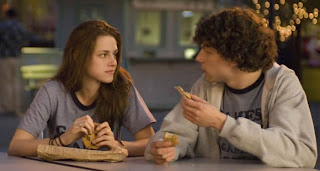
Why it's on the list: A poignant and nostalgic film, Adventureland caught me completely off-guard. It's very funny, but contains much truth about human emotions (or more specifically, teenage emotions). It perfectly depicts the awkward transition phase between college and adult life (yes, I am avoiding the phrase "coming-of-age"), and Jesse Eisenberg plays awkward more sincerely and MUCH less annoyingly than Michael Cera. Eisenberg transforms his character James into an honest three-dimensional character, avoiding the self-aware quirks of the characters Cera tends to inhabit. Mottola and Eisenberg know how to create pathos, and do it well, without being abrasive or fake.
Best scene in the movie: Any one with the combined trio of Bill Hader, Kristen Wiig, and Jesse Eisenberg.

3.) Inglorious Basterds, directed by Quentin Tarantino
http://www.imdb.com/title/tt0361748/
Why it's on the list: It's the most brilliantly written film of the year, and also contains my favorite performance of the year, by Christoph Waltz as Colonel Hans Landa of the SS. Perhaps the most self-referential contemporary director, Tarantino rewrites history and does it with wit, humor, and absurdity. "This just might be my masterpiece," says Lt. Aldo Raine at the end of the movie. Yeah, Tarantino might be the most condescending director working today, but he sure wasn't wrong when he wrote those words.
Best scene in the movie: The very first one, when Landa interrogates a farmer who is hiding Jews in his home. The slow build-up of tension and looming dread is wince-inducing, and if that scene's not proof enough of Waltz's acting ability, then I don't know what is. Thankfully, Waltz has been casted in more movies that should hit American shores. Which is good, cause he is the man.

2.) A Serious Man, directed by Joel Coen
http://www.imdb.com/title/tt1019452/
Why it's on the list: Joel and Ethan Coen can do no wrong in my mind. They composed two of the greatest films of all time, Fargo and No Country for Old Men, and now A Serious Man can be added to the list. As many have pointed out, this is the kind of film you get to make after you've won an Oscar. Some say the film is a modern-day retelling of the Book of Job, as Larry Gopnik battles with his faith and his family for his sanity. A Serious Man is a film which deftly explores religion and the existential crises it invokes, and it's also one of the most beautifully photographed films of the year (thanks to long-time Coen collaborator Roger Deakins).
Best scene in the movie: The final scene, with Larry's son transfixed on the tornado. It's a scene that will rock you to your core. You don't have to ask what it means or what it symbolizes - it's what you take from it that matters.

And the best movie of the year...
1.) The Hurt Locker, directed by Kathryn Bigelow
http://www.imdb.com/title/tt0887912/
Why it's the best film of 2009: The Hurt Locker is extraordinary. It is not quite an art-house film and not quite a summer blockbuster, but never before has a film drawn such deep and real characters from so little. It doesn't need to be said, but Jeremy Renner is phenomenal in his role as a bomb defusal expert, and the supporting cast is just as good, with cameos from Ralph Fiennes and Guy Pierce, among others. The tension in the film is nearly unbearable, and not just thanks to the editing and performances, but from the screenplay. The stakes are so much higher when we're given characters to care about - you don't want to look but you can't tear your eyes from the screen. Everything from the beautifully gritty cinematography to the heart-stopping editing is remarkably orchestrated by Bigelow - she doesn't miss a beat. It is, simply put, a perfect film, in every way. Perhaps most importantly, it doesn't let politics get in the way of war; there is no take-home message except for the quote which opens the movie: "The rush of battle is a potent and often lethal addiction, for war is a drug." And there's really nothing else you need to know.
The best scene in the movie: Saying every scene is the best scene is sort of a cop-out, but the meticulously constructed bomb defusal scenes are A-MA-ZING. Seriously. They may not revolutionize suspense, but they have figured out the formula for it. Suck it, Hitchcock.

Thursday, May 7, 2009

American-izing the un-American

(Before you read this, I have to state that I never mean to offend anyone with my personal rants, heavy sarcasm, or taste in movies. Liking a film or not liking a film is based on personal taste alone. There is no right and there is no wrong, which is why movie criticism is such bulls***.)

Tomorrow, a British drama film entitled Little Ashes (dir. Paul Morrison, 2009) is being released in the US, and it brings up an issue that would appear irrelevant to most audiences. The film concerns the life and work of a young Salvador Dali and his supposed relationship with poet Federico Garcia Lorca while living in Franco's Spain, and although the film concerns Spanish affairs and artists, it was financed and shot in the UK. This, I have no issue with.

The issue is that director Morrison chose to have all the actors, even the native Spaniards, speak accented English instead of, oh I don't know, Spanish? By taking away the language of Spain - the same language that Dali, Bunuel, and Lorca actually spoke - Morrison is also taking away what is inherently Spain's culture. He is displacing a piece of Spain's history that in no way belongs to Britain.

How wrong would it be if a film about the American Revolution were shot using French or German actors speaking in their English-accented native language? And how much of a problem would us Americans have with that sort of a film?

The recent Tom Cruise shitfest Valkyrie (dir. Bryan Singer, 2008) took the same liberty, only telling a German story instead of a Spanish one. However, Singer wholly American-ized it, adding explosions, tension, and a hilarious (not in a good way) Tom Cruise performance. It's laughable to me that films like this can get made. How can people, especially the Germans, be okay that Scientologist (a "religion" considered a cult in many parts of the world, including inside my head) Cruise is playing one of Germany's most honorable men, Claus von Stauffenberg? And without telling the story in German, not even with German-accented English? (In all fairness to Mr. Cruise, he did appear in the so-so The Last Samurai, a film for which he spent two years learning Japenese). Language is an important, nay essential, part of any culture, and taking that away can certainly send a message to some ignorant viewers that the story no longer belongs or is deserved by its native country.

Don't get me wrong, I'm okay with telling stories from other countries. But the key is: If it is to be done, it must be done well, or not at all. De Niro learned Italian for The Godfather: Part II, and even though the film is not centered on a historical figure, Coppola does give us a pretty accurate experience of the feeling and culture of Italy. Julian Schnabel's recent mind-blowing film The Diving Bell and the Butterfly (2007) was based on the memoir of a French fashion editor, Jean-Dominique Bauby, who suffered from "locked-in syndrome." The film was originally slated to be in English and financed by Universal Studios with Johnny Depp in the lead role. Schnabel admirably contended that the English language could not do justice to the words that Bauby wrote and, despite extreme pressures to the contrary, made the film in French. He even more admirably learned French so that he could direct the film, which later provided him with an Academy Award nomination for Best Director - although it should have been a win as well.

The unfortunate feeling I have is that modern audiences are afraid of the subtitle, now a wholly realized fear as I am seeing signs at the ticket kiosk in theaters reading: Pan's Labyrinth/Y Tu Mama Tambien/The Orphanage/Insert Film Here is in Spanish with English subtitles. If you are dissatisfied, please see the manager for a full refund within the first fifteen minutes of the showing. This disturbing trend epitomizes the contradiction of rampant Americanism, and is certainly challenging, if not outrightly destroying the notion of US hegemony because of Americans' refusal to accept something that is not ours. We are telling stories that don't belong to us and not doing it well, or giving the culture or country the story belongs to adequate credit.

Franquist Spain, I'm sure, wasn't a great place to live for Dali, Bunuel, and Lorca, but is this country full of lazy moviegoers any better?

Saturday, April 25, 2009

Fame perceptions

I stumbled across this article online and found it really interesting. The article written about this experiment won a Pulitzer Prize in 2008, and is endlessly fascinating in its implications it suggests for our perceptions of fame, talent, and stardom. The original article was featured in the Washington Post, and this shortened version was taken from Ego Dialogues ( http://www.egodialogues.com/general/violinist-in-metro.php).

"A man sat at a metro station in Washington DC and started to play the violin; it was a cold January morning. He played six Bach pieces for about 45 minutes. During that time, since it was rush hour, it was calculated that thousands of people went through the station, most of them on their way to work.

Three minutes went by and a middle aged man noticed there was musician playing. He slowed his pace and stopped for a few seconds and then hurried up to meet his schedule.

A minute later, the violinist received his first dollar tip: a woman threw the money in the till and without stopping continued to walk.

A few minutes later, someone leaned against the wall to listen to him, but the man looked at his watch and started to walk again. Clearly he was late for work.

The one who paid the most attention was a 3 year old boy. His mother tagged him along, hurried but the kid stopped to look at the violinist. Finally the mother pushed hard and the child continued to walk turning his head all the time. This action was repeated by several other children. All the parents, without exception, forced them to move on.

In the 45 minutes the musician played, only 6 people stopped and stayed for a while. About 20 gave him money but continued to walk their normal pace. He collected $32. When he finished playing and silence took over, no one noticed it. No one applauded, nor was there any recognition.

No one knew this but the violinist was Joshua Bell, one of the best musicians in the world. He played one of the most intricate pieces ever written with a violin worth 3.5 million dollars.

Two days before his playing in the subway, Joshua Bell sold out at a theater in Boston and the seats average $100.

Joshua Bell playing incognito in the metro station was organized by the Washington Post as part of an social experiment about perception, taste and priorities of people. The outlines were: in a commonplace environment at an inappropriate hour: Do we perceive beauty? Do we stop to appreciate it? Do we recognize the talent in an unexpected context?

One of the possible conclusions from this experience could be:

If we do not have a moment to stop and listen to one of the best musicians in the world playing the best music ever written, how many other things are we missing?"

Monday, April 20, 2009

P2 Review

P2 (2007): A film by Franck Khalfoun

P2 is not quite as good as classic horror films like Night of the Living Dead or Suspiria, but it is far superior to many horror films as of late. Critics tore the film apart, many passing it off as just another schlocky and campy B-movie, worthy of nothing less than harsh words and box office failure. The film, however, displays a tremendous amount of promise in the first few scenes but begins to slowly and gradually lose that promise until around the 3/4 mark, when the audience is effectively exhausted and the film amounts to nothing more than just another horror film. Upcoming films should use P2 as a wobbly foundation upon which to rebuild the structure of modern horror.

Angela (Rachel Nichols) is stuck working late on Christmas Eve, her asshole boss making her redo reports over and over again in her large office inside a Manhattan skyscraper, her family nagging at her to get home as soon as possible so they can start dinner, and one of her co-workers sincerely apologizing for groping her at a recent Christmas party. She eventually gets out of her office and down to the parking garage to head to her family party, but...her car won't start. Sigh.

She begins to try and find more and more ways out of the parking garage - more likely than not her version of purgatory - and we slowly begin to sense that, failed attempt after failed attempt, something more sinister is at work here. Enter Thomas, the kindly parking garage attendant who helps Angela out and figures since she can't leave, why not have a quaint Christmas Eve dinner in the attendant's office? No, she says, she can't dissapoint her family. But maybe some other time. You see where this is going, I'm sure.

Thomas, of course, has been stalking Angela, and knows just about everything about her. He knocks her out, ties her up, and makes her eat that quaint dinner with him. Thomas, played with insane over-the-topness by Wes Bentley, has a Norman Bates-esque feel about him. He is seemingly gentle, kind, quite a good conversationalist, with boyish good looks and a naive innocence, but he's, well...just a little insane, is all.

And the cat-and-mouse game begins.

Although rather formulaic and predictable, the movie displays enormous potential for topical issues, in particular sexual harrasment. Unfortunately, P2 fails to say (or try to say) anything relevant about the glass ceiling, or sexual harassment, or anything about feminism in general. Such a shame that a technically-competent and, yes, even sometimes suspenseful film could waste its nearly two hours teasing us with social commentary but never quite reaching it. This film is not to be taken as 28 Weeks Later or the aforementioned Night of the Living Dead should be. P2 is a horror movie through and through, both on the surface and in the shallow subtexts, without socio-political commentary. The poorly-lit parking garage at night, a classic fear for women (and men for that matter), would have been a wonderful place to explore the troublesome state of women in the workplace.

The film is high on gore in individual scenes; the violence is well-contained into one horrifically gruesome death and a few shorter scenes of quick but bloody stabs, punches, etc. Thankfully, except for that gratuitous scene, the movie is quite low on sadism. Director Khalfoun manages to ramp up the creepy thanks to a few classic Christmas songs and keeps the claustrophobic feel throughout the film, lost in a maze of cars and identical-looking levels of the parking garage.

Also notable is P2's way of manipulating us to pity Thomas while simultaneously hoping for Angela's escape. Thomas outwardly admits he's lonely - he is a graveyard shift parking garage attendant, after all. We feel bad. He even says he would never want to hurt Angela, which seems to be true at first, but is quite untrue as we later learn. I, for one, genuinely believed Tom's promise, keeping in mind he never said anything about hurting those around her. This interesting pact is not to be seen later in the movie. Was it to make the film more of a horror film and the threat to Angela more real, or did he never really plan on keeping his promise in the first place? I'm not sure.

We understand Tom is lonely, but do people as seemingly kind and good-looking as him really have to go to this length to get a girl to have dinner with him?

Feels like it sometimes, doesn't it?

Saturday, April 18, 2009

Auteurist analysis of Orson Welles

Auteurist analysis of Orson Welles’s "Citizen Kane" by J.D. Santo

Citizen Kane (US, Orson Welles, 1941, 119’), although Welles’s first feature film, laid the ground for themes, techniques, and stylistic tendencies that would appear later in his career in more distinctively film noir works such as Touch of Evil and Lady from Shanghai. According to Andrew Sarris’s auteur theory, which is the most practical (in that we are not so much interested in change over time as Peter Wollen’s auteur theory is, but can instead begin to link similar themes, techniques, and stylistic tendencies by viewing just a few of the director’s works), a director’s worth as an auteur can be displayed through his technical competence, recurrent style, and interior meaning. (Here, I take recurring themes throughout Welles’s oeuvre to reflect his interior meaning). Welles’s “overfondness for the baroque,” as André Bazin so succinctly described it, along with deep focus/deep space compositions, elaborate choreography, and high-contrast lighting in Citizen Kane all compliment Welles’s examination of corruption, isolation, and the downfall of a powerful man. These themes and technical aspects are no doubt shared throughout Welles’s body of work, which leave a distinct “signature” on all of his films, thus making Citizen Kane a most important piece in Welles’s overall oeuvre as an auteur.

Welles’s “overfondness for the baroque” and exotic visuals permeates through all of his films, Citizen Kane firstly and therefore most importantly. The most obvious example in this sense is Kane’s extravagant mansion, Xanadu. Packed with statues, artwork, and lavish furniture, Xanadu’s elaborate mise-en-scéne provides a contrast to Welles’s recurring theme of isolation. (Because the theme of isolation is so closely related to the theme of downfall, I will use the two nearly interchangeably). Kane’s attempt to buy affection, particularly that of his second wife, Susan Kane, ends up driving those closest to him further away. Kane insists that the couple has everything they could ever need or want in their palace; Susan, however, is most dissatisfied with her situation (“49,000 acres of nothing but scenery and statues,” as she describes it) and causes Kane to descend into the most reclusive depths of isolation by leaving him. Kane is now a man who has everything in the world and yet nothing of value, isolated in the very palace that he believed would win him much affection and praise. Welles’s extravagance of mise-en-scéne, along with his fondness for sensational stories, is also contrasted with the realism that is provided through Welles’s use of long takes and deep focus.

Welles displays his tendency to use deep focus/deep space composition to compliment his themes in one scene early on in Citizen Kane, notable in the fact that we can learn just as much from the images on the screen as we can from the dialogue. As Mary Kane and Kane’s father are inside their home signing the document to turn their son, Charles Foster Kane, over to Walter Thatcher, young Charles is playing outside in the snow. In the foreground to the right of the window is Mary Kane, in the midground to the right of the window is Walter Thatcher, in the background to the left of the window is Kane’s father, and in the extreme background through the window we can see Charles, in complete focus, playing in the snow. This feat (presenting the entire frame in sharp focus) is not easily achieved, as it requires not just the technical competence of a good director but the technical mastery of a great one; deep focus is achieved only through the perfect amount of lighting. The choreography and placement of the actors in the scene is key, reinforcing the fact that Charles is literally “coming between” between the adult characters while also reflecting the coldness of the Kanes’ marriage and displaying Charles’s isolation by his parents.

Welles uses low-key, high-contrast lighting and chiaroscuro to compliment his diegesis as well. The chiaroscuro provides a contrast, as Welles often uses, between the moral and the immoral, the right and the wrong, the “clean” and the “dirty.” Borrowing a technique from German Expressionist films, Welles tends to use lighting and shadows that distorts or hides the faces of the immoral or “dirty.” When the morality of a character in Welles’s film is ambiguous, as it so often is, the lighting in the scene often depends on its context. For example, there is a scene just after Susan Kane’s regrettable performance in the opera house where Kane is completing a drunken Jedediah’s scathing review of Susan’s amateurish singing. Kane is in the foreground, shadows on his face, partially outside of the frame, while Jedediah is completely within the frame, well-lit. Welles viewed Jedediah’s honesty and subjective opinion in his review of Susan’s performance as noble attributes, even though Jedediah likely knew the consequences of his candor.

Welles would continue to use low-key lighting, deep focus/deep space compositions, choreography and extravagant mise-en-scéne to accentuate his most-favored themes of isolation, corruption, and the downfall of a powerful figure in his subsequent films, particularly in Lady from Shanghai and Touch of Evil. Welles is most successful as an auteur in that he manages to rather loosely connect all of his films with one another not just through film technique but also through several recurring themes, displaying a marvelous technical competence along the way. It is most difficult to precisely define an auteur, but perhaps Sarris’s most simplified theory, which adheres most faithfully to François Truffaut’s original vision of the theory, is correct. Truffaut’s “politique des auteurs,” the basis of auteur theory, contends that a true auteur’s work must display consistencies in themes and style, leaving a distinct “signature” on each of his/her films. Welles most certainly leaves his signature on his films, filling them with the sensational, the extravagant, the powerful, and the corrupt using film technique that is inarguably his own.

Reworking the gaze in Pedro Almodovar's "Volver"

I wrote this for my film studies class last quarter:

Reworking Mulvey's "gaze" in Pedro Almodovar's Volver by J.D. Santo

Laura Mulvey’s concern with the depiction of women in unchallenged, mainstream film is becoming more and more pertinent as misogynistic films in the “torture-porn” genre such as Hostel: Part II (US, Eli Roth, 2007, 94’) and seemingly innocent “buddy comedies” like Superbad (US, Greg Mottola, 2007, 114’) continue to treat women as sexual objects to be ogled and manipulated. These exploitative films are cementing Mulvey’s belief that women fulfill the viewer’s desire for scopophilic gazing and voyeuristic fetishes. Volver (Spain, Pedro Almodóvar, 2006, 121’), however, is able to deftly and beautifully portray an emotional and feminine community of women intent on supporting, loving, and helping one another while simultaneously celebrating their very womanhood, their unabashed sexuality. By using precise shots and juxtaposition within the frame, structuring the viewer’s gaze so that he/she feels uncomfortable in alignment with the male gaze (and therefore comfortable with main female protagonist Raimunda’s gaze), creating misogynistic male characters, and refusing to allow Raimunda to abandon her sexuality, Almodóvar creates in Volver a film that celebrates the fierce sexuality and femininity of Raimunda. Volver challenges the dominant patriarchal order and allows women to transcend the female-dominated role of spectacle in cinema, and could thusly be considered to be a member of what Mulvey describes as the “alternative cinema,” a group of films which challenge the basic assumptions of the mainstream film.

Almodóvar’s precise attention to his visual representation of female sexuality is key in Volver. Most notable is a series of disjointed scenes concerning the murder of Raimunda’s husband Paco by their daughter Paula (who is also Raimunda’s sister, due to her father raping her). Firstly, a high-angle shot from directly above displays Raimunda’s cleavage on the right side of the frame and her outstretched arms cleaning various dishes on the left side of the frame; lastly, she cleans a large kitchen knife. In a later shot, Paula has murdered Paco because he attempted to rape her. In order to protect Paula from prosecution, Raimunda uses a mop and paper towels (tools typically associated with domestic housewives) to clean up the blood. The payoff shot occurs in the subsequent scene which utilizes the same high-angle shot from earlier; this time the knife is soiled with blood of Raimunda’s husband instead of food.

This series of shots inextricably links the female as being not just a symbol of power but also a very real threat of castration – an “anxiety” (p. 718), as Mulvey describes, that men try to escape either through fetishistic scopophilia or voyeurism/sadism. The scene most importantly structures the viewer’s gaze to look directly down Raimunda’s shirt to her breasts. This would be considered “one part of a fragmented body” which gives “the quality of a cut-out or icon” (p. 716), yet the shot cements Raimunda’s status as an empowered female (and domestic housewife) by juxtaposing a symbol of sexuality in Raimunda’s breasts with the image of the bloody knife.

Two of three males given crucial roles (not to be mistaken with leading roles) in the film – Paco and Raimunda’s husband – are sexual perverts. Although the gaze throughout the film is structured almost entirely according to Raimunda (a gaze where the viewer feels comfortable because of her loving, compassionate nature and devotion to family), Volver’s gaze is structured with Paco’s voyeuristic point-of-view twice in the film, both times providing discomfort in “gazing” with a chauvinist. The viewer is first aligned with Paco’s gaze as Paula sits next to him with her legs spread while Paco (and therefore the viewer) stares at the outline of her vagina clearly visible through her tights. The subsequent alignment of the gaze shows Paula topless in her room with her door slightly cracked while Paco stands in the hallway peeking in. Both times, even though the gaze is aligned with a male character, the viewer is made sexually uncomfortable because they understand that this voyeuristic gazing is morally wrong.

Almodóvar seems to play with Mulvey’s notion that individualistic women in film typically become the “property” of the men by the end of the film and therefore lose their “outward glamorous characteristics, generalized sexuality, [and] show-girl connotations” (p. 718). The appearance of the boyish, attractive, charming male filmmaker who pays Raimunda to cook dinner for his crew causes the viewer to infer that a romantic relationship will be pursued, which would diminish the threat of castration in Raimunda and allow a man to possess her (and therefore allow the viewer to “indirectly possess her too”) (p. 718). Ironically, however, Raimunda seems almost inconvenienced by the filmmaker. (In one scene in particular, Raimunda is on the phone with her sister Sole discussing their recently-deceased aunt’s funeral and is approached by the filmmaker. During their conversation, she smiles and flirts to appease him but rolls her eyes and sighs after he leaves. Raimunda is clearly not concerned with romantic pursuits and instead puts her family issues first and foremost).

Mulvey encourages an alternative cinema to develop as a counterpoint to dominant Hollywood cinema where woman stands “in patriarchal culture as signifier for the male other…still tied to her place as bearer of meaning, not maker of meaning.” Volver is not politically or aesthetically avant-garde in the traditional sense (i.e., it does not demand or even suggest a revolution in the depiction of women in the cinema), but it certainly constructs Raimunda as a woman who is at once strong-willed and beautiful without fear of expressing her femininity or fierce sexuality. Therefore the film should most certainly be considered one which reacts against the “obsessions and assumptions” (p. 713) of mainstream film by depicting Raimunda as strong and sexualized while depicting men as unimportant at best, sexual deviants at worst.

Thursday, January 8, 2009

Papillon Review

DVD Review
Papillon (1973): A Film by Franklin J. Schaffner

"Papillon" is a true story which, I have no doubt, has been given the Hollywood treatment, scandalized and hyperbolized. It is the supposed, without meaning offense, true story of Henri "Papillon" Charriere (Steve McQueen), a man wrongfully imprisoned for a murder he did not commit. He befriends, or more specifically, bargains with Louis Dega (Dustin Hoffman) in order to become friends. Papillon agrees to serve as a bodyguard to Dega while in prison, as Dega has become rich off of counterfeiting government war bonds and is a prime target for the other prisoners to kill, beat, or rape in order to take the money he is smuggling into the penal colony. In return, Dega will help Papillon fund his escape from the penal colony.

The story progresses, as one could expect, into the two becoming close friends whose mutual care help each other survive in conditions that would turn men into animals. After Papillon is placed in solitary confinement for a botched first escape attempt, Dega bribes a guard to place half a coconut shell into Papillon's water bowl for extra sustinence. Food rations are so scarce that the prisoners result to stealing from dead bodies, which I suspect is not the worst deed that some of the inmates have uptaken.

But, alas, frustration sets in for the audience. What we believe is the final escape attempt takes places at a most opportune time. Audience fatigue is beginning to set in, and it is believed the weariness and exhaustion of earlier, stress-inducing scenes will be relieved by a much-deserved (for the audience and for the prisoners) escape. The escape is botched, once again, and the film continues for another half-hour to forty-five minutes. Asking to cut a half hour from an already two hour and thirty minute film is not much, in my opinion. Enough of that.

The film also suffers from problems with tone; at times the film seems to want to be a buddy comedy, at other moments the film becomes heavy-handed and drawn out. Near the end of the film, in what is a strange scene indeed, Papillon arrives (I will not explain how) at a village with natives; the males are wearing next to nothing, the females even less so. Body and face paint and tribal weapons adorn their bodies. Papillon has what is assumed to be a sexual relationship with one of the female villagers, paints a butterfly on the tribal leader's chest, and one morning he wakes up and they have departed. I did not understand the significance of the scene, but I certainly hope it has one. The scene disrupted the flow of the movie, the tone, the wonderful gritty realism of prison escape drama. Not a word of dialogue is spoken for what must be at least ten or fifteen minutes in the scene with the natives. Ah, but I make a big deal out of time. "Time is but a stream I go a-fishing in," as Henry David Thoreau once wrote.

The film is ultimately satisfying, although it takes many lengthy detours to get there. The emotional fufillment between Dega and Papillon at the end of the film is ultimately less than stellar, but we must also consider the circumstances and reasoning that their relationship was founded upon. Individual scenes, such as the haunting sequences of Papillon's solitary confinement, are superb. Thus, the most fitting description for "Papillon," I suppose, would be that the whole is less than the sum of its parts.

Rating: 3/4 stars

I'll Sleep When I'm Dead Review

DVD Review
I'll Sleep When I'm Dead (2003): A Film by Mike Hodges

"I'll Sleep When I'm Dead," I feel, has wasted an hour and forty-five minutes of my life.

Allow me to be more fair.

"I'll Sleep When I'm Dead" has wasted an hour of my life.

The problem with this particular piece of film noir is that there is too much noir: too much mystery, not enough explanation. When the payoff finally comes - well, you wish you were a gangster so you could snuff out everyone involved in this frustrating excuse for a gangster film. The audience waits and waits for the carpet to be pulled out from underneath them. The problem is that they stay standing on the carpet the entire length of the film, from the first line of dialogue to the last credit in the reel. Well, what the hell do we do now?

The first half hour or so of the film is fantastic - moody, menacing, and mysterious. Clive Owen plays Will Graham, a gangster who has finally retired to a peaceful, retreated life of lumberjacking. That's right - lumberjacking. He has essentially cut all ties from his former life, including his brother Davey who, since his brother's disappearance, has turned to a life of drug peddling and stealing anything not nailed down to the floor. Also left behind is Will's (apparant) ex-girlfriend Helen, Will's relationship with whom is never particularly explained well, or at all for that matter. For exactly what reason Will left the mob, his family, and his friends behind is never explained either, although one character explains he had a "breakdown." Another refutes that Will is too tough to have ever suffered from one.

The first act of the film has a sort of silent terror to it. We know something inevitably horrendous will happen, but we know not when, how, or by whom. Will, after all, needs to come out of retirement. Wanna know the reason? I'm telling you anyways. Davey slits his own throat for reasons immediately unknown to us or to Will. Davey's close friends say it was a shock - Davey was essentially happy; he had money and a beautiful woman (and, really, what more could you ask for?). Out comes Will for vengence.

I waited the entire film, even until the end credits, to see when the story - and backstories - would start to develop. When would we get to learn more about these characters, thier pasts, their rapports? Why would a seemingly happy young man try to kill himself? What happened in Will's old days as a mobster? Exactly who is Helen, and what happened between her and Will? Question after question develops, but very few are answered. Even when a question is answered, rarely is it a satisfactory explanation. In one of the last few scenes of the film where Will finally gets his revenge, the confrontation lasts not nearly long enough, and the main antagonist's reasoning is so flimsly that I wish as though I could forget it altogether and come up with my own explanation.

So my final question is this, directed at writer Trevor Preston: Why waste a viewer's hour and a half building up anticipation when all you're planning to do is disappoint?

Rating: 1.5 /4 stars

Monday, January 5, 2009

Milk Review

Milk (2008): A Film by Gus Van Sant

Gus Van Sant returns to mainstream filmmaking after the startlingly beautiful and haunting "Paranoid Park" with an equal of elegance and grace in "Milk," one of the most heartfelt, rousing stories ever to hit the silver screen. Sean Penn plays the politico Harvey Milk, the first openly gay public official elected to major office in the 1970s. In a performance that is sure to nab him an Academy Award win (or a nomination at the very least), Penn downplays his role, making Milk wholly human, although at times his persistence and bravery make him quite the superhero.

The film follows Milk's lengthy road from being a hippie businessman with a camera shop in San Francisco in the Castro district to becoming a member of the board on San Francisco Board of Supervisors. Along the way, he meets many sympathetic to his cause of gay rights, but much more opposition. On the opposing team is Dan White, a fellow member of the Board, who is a blatant homophobe, although some of Milk's team suspect that he may be "one of their own." White, played hypnotically by Josh Brolin, is willing to work with Milk, but only if Milk agrees to support some of his own interests. Milk refuses and makes himself an enemy (sort of). Thankfully, San Francisco mayor George Moscone (Victor Garber) is supportive of Milk's endeavors and is one of the few politicians willing to work with Milk and his allies.

Milk encourages gay youth to "come out of the closet," and in doing so, inspires an entire community and more. He fights against the unethical and most certainly unconstitutional Proposition 6 in California, a law that would have banned all gay teachers from working in public schools. The proposition sadly parallels the recent Proposition 8 in California, which passed, effectively banning gay marriage. Milk and his team were able to defeat the shameful Proposition 6.

His political life, as it always does in American politics, got in the way of his personal relationships. His relationship with Scott Smith (James Franco), a man whom it seems Milk truly loved, was destroyed by days and nights of campaigning, canvassing, and protesting. His next relationship with Jack Lira (Diego Luna) takes an even more tragic turn. Milk was a man so selfless, so dedicated to his cause, that he gave up everything of his own so that a community being persecuted, being denied basic human rights, could have just a little hope to cling onto. When it comes to tragic figures, even Macbeth has nothing on Harvey Milk.

The sad ending to the story is widely known. White enters City Hall after being fired from his position on the Board of Supervisors, and assassinates Milk and Moscone. The film is not a political thriller and is never centered on the assassination, and it shouldn't be. "Milk," appropriately, is a celebration of life, a tribute to the hope a man had while living in a hopeless world. The story is ultimately a tragedy, but moments of heartfelt and sweet-natured comedy keep the film's head from sinking into tepid melodrama. Delicately handled by Gus Van Sant, a director who I am now convinced is a master, "Milk" is not only an important film, but once which should be required viewing for all Americans. Van Sant restores hope to those who believe in basic human rights for all, and as Harvey Milk said once himself, "You gotta give 'em hope".

Rating: 4/4 stars

Sunday, November 23, 2008

Synecdoche, New York Review

Synecdoche, New York (2008): A Film by Charlie Kaufman

Charlie Kaufman, the scribe of such refreshing films as "Eternal Sunshine of the Spotless Mind," "Adaptation," and "Being John Malkovich," can add another incredibly impressive work to his resume. Whether or not "Synecdoche, New York" will be considered his greatest masterpiece is arguable, but I would like to argue for it.

Looking at Kaufman's overall oeuvre, it can be noted that all of his films have to do with the identity, memories, and such horrors as loneliness, death, or more appropriately, dying lonely. "Synecdoche" follows in the footsteps of Kaufman's previous works by introducing us to Caden Cotard, played by Philip Seymour Hoffman. Caden is suffering from some sort of disease that doctors cannot identify, a disease in which the only thing that is known is that he will die. The women he loves eventually leave him because of his depression, his sickness, and his inability to remain faithful to those he is with. Do these women love him or pity him so much as to sleep with him?

From my description, Caden may sound like an unenjoyable, depressing main character. He absolutely is. The key to the character, though, is that you can identify with him, which remains of upmost importance to his likeability. We do pity him, yes. Does that mean we also pity ourselves? Possibly. We all want to be loved, we all want someone to "complete" us, we all want to be good people and satisfy everyone around us. So does Caden.

The story, in short, as to not ruin any of the inventiveness of it or make a futile attempt at the labarynthine plot, is as follows: Caden is awarded a MacArthur Genius Grant and attempts to stage a play in an enormous warehouse in New York City. Inside the warehouse, a replica of New York City is built. The problem is, if there is a replica of New York City in the real warehouse, a replica of the warehouse must also be built, and a replica of that replica, and so on. Caden has actors and actresses play people he knows and interacts with, namely his wives, mistresses, etc. Once again, the problem here is that he must then find actors and actresses to play the actors and actresses playing real people in his life, and so on, and so on, and so on. Get it?

I read in an interview that Kaufman was originally slated to write a horror movie, which eventually developed into this script. Though it would not be traditionally labeled a horror movie, it is incredibly frightening in its exploration of loneliness, isolation, imminence of death, and the nature of identity. The movie provides plenty of humor, most especially from the wonderful performances, but it's not likely to have you clinching your sides as much as chuckling to yourself while you squirm at the uneasy truthfulness of it all. The last few scenes in the movie I will have to watch again to determine exactly what I saw, but the very final scene in the movie is unlike anything else you will see in the movies today. Guaranteed.

Kaufman's movies were never meant to be understood or dissected in a solitary viewing. Watch "Eternal Sunshine" a few more times to obtain the total emotional resonance. Kaufman's directorial debut, "Synecdoche, New York," I suspect, is no different. I have not yet come across a screenwriter with such talent, wit, and human understanding as Charlie Kaufman. He certainly has given David Mamet a run for his money, and with "Synecdoche, New York," I suspect Kaufman finally proves that he is the single most talanted screenwriter working in Hollywood today.

Rating: 4/4 stars

Sunday, November 2, 2008

Brand Upon the Brain! Review

DVD Review
Brand Upon the Brain! (2006): A Film by Guy Maddin

The primary function of the movies is to entertain, is it not? This would be where the term "the entertainment industry" is derived from.

"Brand Upon the Brain!," Maddin's homage to the silent film area, is nauseating. I have never been an enormous fan of the abstractness or pretentiousness of avant-garde films such as this. I believe that every film should maintain the capacity to entertain, make us think, and present us with something new every time. Well, one out of three ain't bad. This is my first time seeing a Guy Maddin film. I pray it is not considered his magnum opus.

The film follows around our hero, named (what else?) Guy Maddin. Guy and a group of orphans live in a lighthouse and are constantly watched over by their dictatorial and overbearing mother. Meanwhile, Guy's father, who is elusive and mysterious, works on strange experiments in his basement.

The plot somehow introduces sibling sleuths by the name of "The Lightbulb Kids" and several other quirks, but story doesn't matter here as much as style does.

The frantic editing and pace contribute to the nauseousness of the film. A barrage of sounds and sights (mostly sights) frustrate to an unbearable extent. Characters we care about, or are at least interested in, are an integral part of a successful film. "Brand Upon the Brain!" creates neither. The only noteworthy concept the film maintains is that I can honestly say I have never, ever seen another film like this one.

Perhaps I do not understand avant-garde films, as I seem to be in the minority in my judgement of the film. The film has recieved overwhelmingly positive reactions from critics. That a film like this could ever get made, with such abstract execution, story, and ideas, amazes me. Don't get me wrong - I am glad it exists, and I hope that one day I will return to it to try my best to understand it. For now, however, it remains nothing more than a series of loathsome Freudian lectures set to classical music, narrated by Isabella Rossellini.

Rating: 0.5/4 stars

Monday, September 29, 2008

Children of Men Review

DVD Review
Children of Men (2006): A Film by Alfonso Cuaron

Very few times, if ever, does a film come along that leaves you breathless, pensive, and enamored all in one fell swoop. There are scenes so real, so visceral, in "Children of Men," that you have to wonder if you aren't watching a documentary.

Although we know we're not, as the film takes place in 2027, less than twenty years into the future. This is not the future we see in Ridley Scott's "Blade Runner" or Steven Speilberg's "Minority Report," with sleek cars with artificial intelligence, robots, or billboards that recognize you by name. No, Cuaron's future is one where everything looks essentially the same, but the places more beat-up, the people more beat-down.

In the first scene of the film, we find that the yongest child in the world, "Baby Diego," has just been killed for not signing an autograph. He was eighteen years old. Everyone in London mourns for him except for our hero, Theo Faron (Clive Owen). Theo is a depressed alcoholic, although the film never makes him into a cliche; we understand why he feels the way he does and why he is such a tortured soul. He finds no refuge in the world other than visiting his eccentric friend Jasper (Michael Caine) who lives in a home hidden away deep in the woods. Without Jasper, Theo claims he would "have nothing to look forward to."

The government, seeing society become a ticking time bomb to extinction ("Last one to die, please turn out the light"), decides that people should be able to decide when they should "pass on." They distribute suicide kids called "Quietus" that allows the user to die quickly and painlessly. The government deports illegal immigrants, packing them into cages, abusing them, killing them, and starving them. We put ourselves in Theo's place and can understand how someone can be so distraught and hopeless. We wonder: would society even function properly if put into this position? Would people continue to go to their jobs, to pay for food, clothes, and shelter? Would the law even uphold? Because as Jasper points out in one poignant scene: "Why bother, if fate's going to make its own choices?"

One day, as Theo is walking in the city, he is kidnapped by the terrorist group The Fishes, who demand equal rights for all immigrants in Britain. The leader of their group is Theo's ex-wife, Julian (Julianne Moore). She asks him to get transit papers so that they can transport a woman, Kee, across Britain. Why or where, Theo doesn't care - he needs the money that is being offered to him for retrieving the papers from his cousin who has a governmental position.

As we discover, and as the viewer could probably suspect, Kee is pregnant with the first baby in nearly twenty years. Some insist that the child recieve proper care at The Human Project, an organization whose exsitence is unknown, but is rumored to be the only group who can properly care for a baby. The Fishes, however, want to use the child for political leverage. One night, while staying at a safehouse owned by The Fishes, Theo, Kee, and Kee's caretaker/midwife Miriam flee. What follows is an extraordinary series of scenes in which Theo, Kee, and Miriam flee from danger, and through a series of dangerous encounters, attempt to get to the buoy where the rescue boat from The Human Project could be awaiting the group - if The Human Project does indeed exist.

The most extraordinary tracking shot I have ever seen comprises one of the final few scenes of the film, following Theo across a battlefield, up a building, and right back down. As we follow him, tanks explode, bullets fly, explosions are caused, and people are killed - all in one astonishing, remarkable, single take. There are several other technically baffling tracking shots in "Children of Men," including a single take in which the car Theo is riding in is set ablaze, the front windshield shot through, and a gunman thrown from his motorcycle, comprising a roughly eight-minute long take. And it's not even the longest one in the film.

The performances, particularly those of Clive Owen and Chiwetel Ejiofor, are remarkable. I couldn't help but notice that in one scene, in which Theo is about to cross a bullet-ridden battlefield, Clive Owen's fingers begin to twitch nervously just before he sprints across the field. His face, his eyes, show such disappointment, such hopelessness, such sadness, that Theo becomes such a real and vulnerable character to us. Such minor touches add up to such a brilliant performance from one of the best actors working today.

The mise-en-scene is incredible; at several points during the film I had to remind myself of the fact that I was watching fiction. Every detail, every building, every car, every person is given such a meticulous and specific look that we feel as if we are watching reality. Cuaron's choice to use lengthy tracking shots add to this overall effect. Such realism is required in a film such as this, in which the place is just as important as the people, and Cuaron couldn't have done a better job at creating his own world so frightening in its concept. We hope that we never have to experience this horror ourselves.

Rating: 4/4 stars

Tuesday, September 23, 2008

Burn After Reading Review

Burn After Reading (2008): A Film by Joel and Ethan Coen

"Burn After Reading" is peculiar, in the Coen brothers sort of way, in that we don't care so much about the characters as we do about the story. "Burn After Reading," starring such A-listers as John Malkovich, George Clooney, Frances McDormand, Brad Pitt, and the always marvelous Tilda Swinton, presents us with a set of characters so unrelatable, so disillusioned, and so strange that they inhabit their own world where everyone is so air-headed that you pray this movie isn't based on a true story.

The plot, although basic and cliche upon first glance, has so many flips, flops, relationships formed, relationships broken, and deaths that it is seems almost fresh, although it could use some tightening. Summed up as simply as possible, Pitt and McDormand play Chad Feldheimer and Linda Litzke, two incompetent gym employees who stumble upon a disc full of "top-secret" CIA information belonging to Osbourne Cox (Malkovich). Clooney plays Harry Pfarrer, the bumbling paranoid sleeping with Cox's wife (Swinton). Chad and Linda attempt to blackmail Cox so that Linda can pay for a pricy plastic surgery operation, and as they say, all hell breaks loose. J.K. Simmons, as a CIA Superior, plays what is undoubtedly the most lucid and comedic of all of the characters, watching this group scramble over documents which he believes are "no biggie." The CIA Superior is just as fascinated with these fools as the audience is. The film is notable in the fact that it does contain wonderful performances from all of the leading members of its cast, and often times shatters typecasting so beautifully that we hope to see these fine actors and actresses inhabit similar roles once again. Seeing Clooney play a character other than a forty something slick is refreshing, and Pitt is excellent playing against cast in the role of the dumbest character in the movie, the gum-chewing, water-bottle-sipping Chad.

As the lives of the characters intersect, although unlikely, we are fascinated not by what will happen to the characters, but as to how the story will conclude itself. After one of the deaths in the film, in fact, I found myself laughing at the irony of it all. There are no protagonists or antagonists, no hero or villain, no melodrama, even a climax is absent - the movie is not much more than watching to see who survives until the final act. There are scenes of surprising tension - I can't help but think of a surprisingly suspenseful scene in which Chad hides in the closet from Harry. Although few survive, the film adheres to the Coen brothers' philosophy that where there is comedy, there is also bloodshed. While I do agree with critics who say the film ends somewhat abruptly, the movie would have overstayed its welcome had it been another fifteen minutes long.

The Coen brothers have a knack for what they do. They have ultimate reign over the area of dark comedy, and will hold it forever in my heart, and in the books. Spike Lee recently criticized the brothers for "treating life as a joke": "
It's like, 'Look how they killed that guy! Look how blood squirts out the side of his head!'" Shame on Mr. Lee. The Coen brothers know what they can do, and they do it better than anyone else, managing to keep it exciting and new every single time without disappointing. Not only that, but they have proven that they can do what no one else thought they could do, beautifully crafting western noir in "No Country for Old Men". That says a lot more for them than the pretentious words coming from the mouth of Spike Lee.

Rating: 3/4 stars